Old Main

Old Main from the south
Celebrating 175 years of Knox College

it comes as something of a surprise to me that I’ve yet to write about Galesburg or Knox (the cow mailbox post notwithstanding since I started this post immediately after finishing that one). the college celebrates it 175th anniversary this year (don’t ask me to type or pronounce the word they came up with to describe the milestone) and Old Main, our oldest building, the building in which I had approximately half my classes, is the last site that remains from the Lincoln-Douglas Debates.

fun fact that I just learned: during renovations in preparation for the College’s centennial, Janet Post saved the building’s original pine timbers (which were replaced with a steel and concrete skeleton) and reclaimed them to use as the paneling in the Common Room. the bricks in the fireplace were also from the original building material (also — they were handmade! presumably just like those on the brick streets around downtown Galesburg).

Old Main from the north side of the building

everyone who went to Knox has an Old Main story of some kind — working your way along your first  Pumphandle line with brand new friends from your suite; watching assigned films for a memorable class you had; migrating to the Common Room to complete an exam in greater comfort; finally getting around to seeing the Lincoln Chair towards the end of your senior year; running into Roger wandering the halls; discovering that there are, in fact, offices in those nooks off the stairs, offices sometimes occupied by department heads; meeting with Dean Bailey for any number of reasons in his office; staring up at the historic building as your commencement speaker addresses your class…

the Lincoln-Douglas debate platform was set up
along this side of the building

at the very least, you’ve told someone the story of how, upon discovering that the platform set up for the fifth Lincoln-Douglas debate butted up against the western doors of Old Main (which, turned out, opened outward, who knew?), Stephen Douglas walked around the building but our 16th President climbed out one of the windows and quipped “At last I’ve gone through college.” the building is fairly drenched in Lincoln history and no matter how much I groaned about trudging up the stairs to class, every time I made the climb I found it supremely cool how the stairs are all grooved from the use of over a century’s worth of students. no two steps are the same and during the winter months you have to watch your step on the smooth, uneven surfaces or you’ll be on your bum at the bottom of the stairs. Old Main engenders still a lot of pride in my alma mater, no matter how many times it tried to toss me down the stairs.

cow mailboxes

have a glass of fresh milk!

today’s post strays from our usual theme of travel and general history in favor of something from my personal history.

it’s a drive that I’ve made many, many times in the last nine years, and one that I mostly hated half the time while I was at school and it stood between me and getting home or me and getting back to Galesburg. I can tell you precisely how long it will take to get from my front door to campus — with variations for a pit stop in either Savanna (where I turn south onto the River Road) or in Freeport (where I often stopped for a snack at Culver’s), how many counties the route goes through (9), not how many times I’ve been stopped at the train tracks that cross the highway in Fulton (because it’s been that many), where houses were foreclosed on long before it was the norm, where buildings have burnt down and been rebuilt … if you’d told me a dozen years ago that I’d make this drive dozens of times, I’d have scoffed. mostly because I’d never heard of any of the towns I drive through south of the border, let alone Knox and Galesburg. now that I only make that drive once a year, at most I’ve come to really enjoy it; it’s novel once again, rather than tedious from making it so frequently, and while I no longer get to watch the changes wrought by the seasons, I do get to watch the changes wrought by the years.

my absolute favorite thing about driving to and from Galesburg is passing the cow mailbox at a farm just south of Freeport, Illinois. over the years, I’ve passed three different versions, the most recent of which went up in the last year. unfortunately, I never got a shot of the first one, but haven’t made that mistake with subsequent ones. I always thought of the first one (above left) as Lucy. this new one seems more like a Buddy. we’ll see if the name still suits him the next time I drive past, or if he’s been replaced by someone new in a few year’s time.

Posted by Picasa

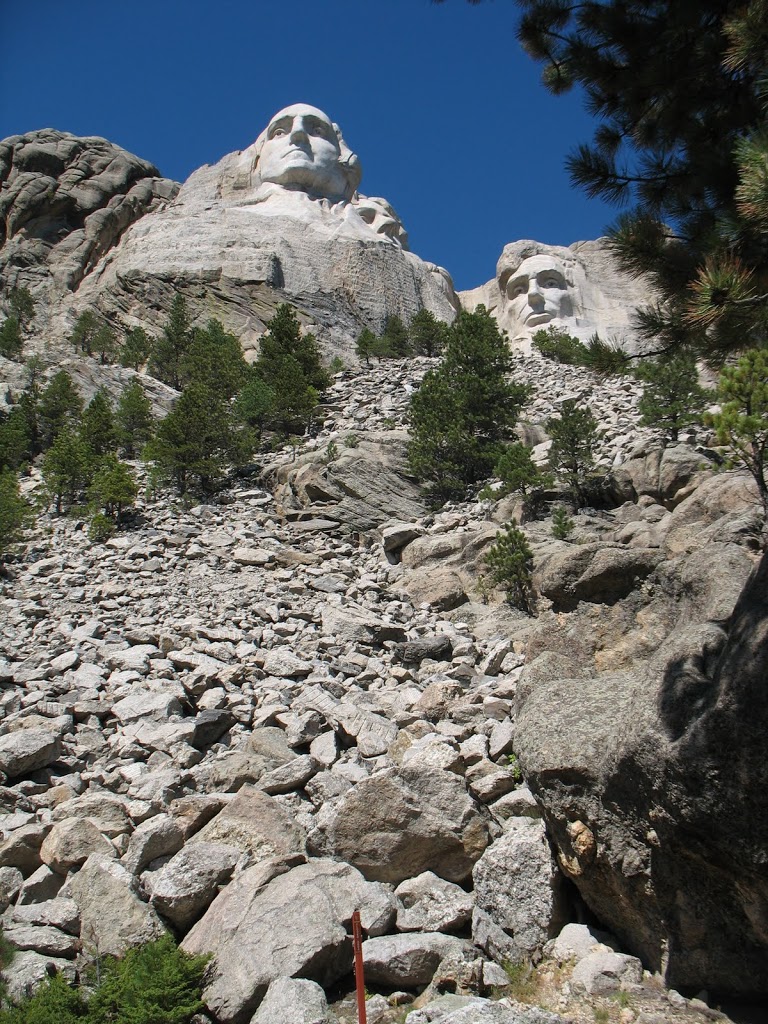
Mount Rushmore


I started this post right after we got back from South Dakota in September, but wasn’t inspired to complete it until I saw a StoryCorps piece on NPR about one of the stone carvers who helped craft the monument.

growing up, my family was big on road trips and on visiting Sites of Historical Importance (see also: Boston’s Freedom Trail) and Mount Rushmore and western South Dakota were on that list. I must have been … between second and third grads, or so. what I remember most from that trip is washing dishes at our campsite in what seemed an unexpectedly dense coniferous forest. it reminded me a lot of the Upper Peninsula of Michigan or northern Wisconsin. also, that the Crazy Horse monument underwhelmed because they’d only completed his forehead and profile of his nose. (also, “Rount Mushmore.”)

one upside to visiting places while young, and returning later, is that appreciation can be twofold. my recollections of Mount Rushmore are vague but rosy and, now that I can place its construction into historical context, I’m rather more impressed.

the massive carving, suggested by Doane Robinson in the early 1920s, sought to entice tourists to the Black Hills. both environmentalists and Native American tribes objected to various proposed locations, but eventually supporters and opponents settled on this mountain (the tallest in the region, renamed for a New York lawyer  from the original Lakota name, Six Grandfathers). (for purposes of this post, I’ll forego discussing the Fort Laramie Treaty of 1868 and ongoing tensions between the U.S. government and the Lakota people for whom the Black Hills are sacred.) Robinson convinced sculptor Gutzon Borglum (who had lately worked on the face of Robert E. Lee at Stone Mountain, Georgia) to come to the Black Hills to ensure the completion of the project. Borglum died before the completion of the monument, but his son, Lincoln, carried on in his stead.

political and financial wrangling ensued: Congress authorized a commission to oversee the project; President Coolidge insisted that, in addition to President Washington, the monument include two Republicans and one Democrat — Borglum based his final selections on the role the Presidents had on preserving “the Republic” as well as expanding territory for said Republic.

between the start of construction in October 1927 and its completion in October 1941, some 400 people worked on constructing the monument. nearly 90% of the carving was done by dynamite; blasters could place charges specifically enough to blast rock off to within 3 inches of the final surface. once it got close enough, carvers switched to jackhammers, drilling a series of holes into the surface in a honeycomb patter to allow for more precise carving. this kicked up an incredible, fine dust. while they were provided with masks to prevent inhalation and subsequent damage to their lungs, the masks were stuffy and, in the direct sun hanging off the rock-face, many workers opted to go without. despite the dangerous working conditions, no one died during the course of the project, something rare for a monument of this size.

while the carvings at Mount Rushmore today don’t match the scope of what Borglum had in mind initially — head-to-waist high sculptures of the presidents, plus monuments to the Louisiana Purchase, Constitution & Declaration of Independence, as well as other territories, what stands today is pretty damn impressive.