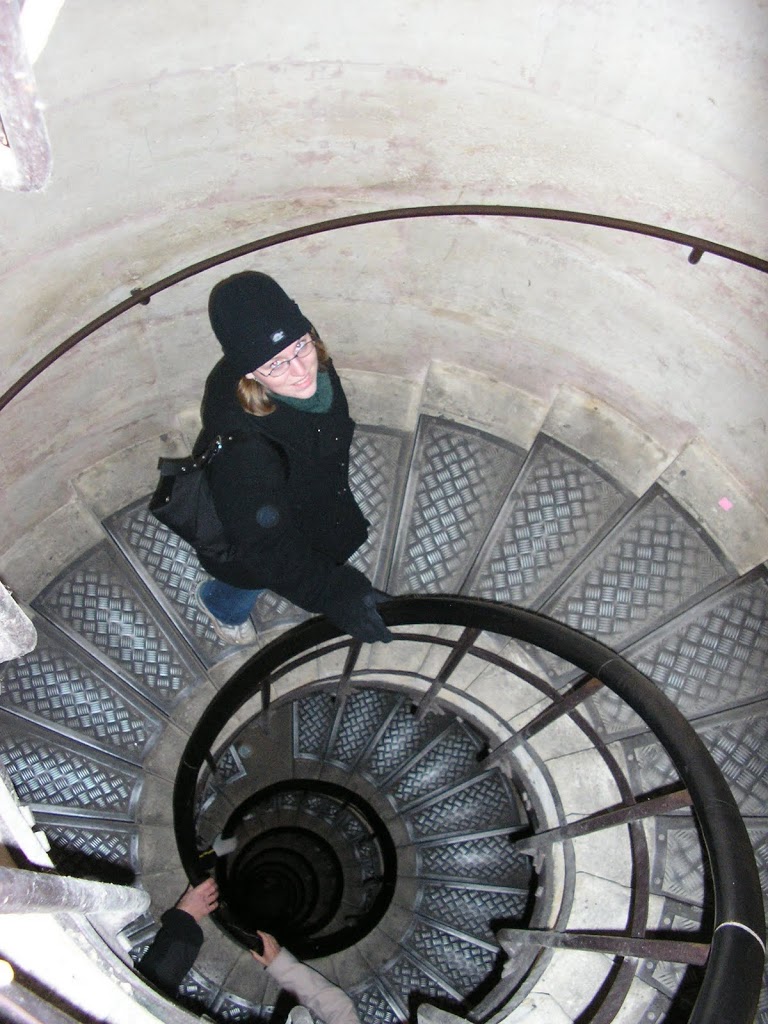
climbing the stairs of the Arc de Triomphe
everyone needs a little travel adventure

instead of taking the elevator and going up in the Eiffel Tower, Becca and I climbed the 284 steps to the top of the Arc de Triomphe.
totally worth it. again.
I first climbed to the top of the Arc de Triomphe at the age of 16, while visiting Paris at the beginning of a three-week tour with classmates from West. following the organized morning activity, Leah and I spent our afternoon at liberty walking from the Place de la Concorde, up the Champs Elysee, to the foot of the Arc de Triomphe, where we met up with the remainder of the group several hours later. a pair of American teenagers (and looking very much the part) meandering along the most famous boulevard in France, window shopping and commenting on the locals. the sun was setting as we reached the top, and I’ve got a fun picture of a group of us with the Tour Eiffel in the background, the sky fading to indigo at the horizon. (but not scanned onto my computer.)
View Larger Map
(really, what did we do before google maps?! my mental map of Paris would be even better than it already is …)
the Arc de Triomphe stands in the center of the Place Charles de Gaulle and is the linchpin of the axis historique, a sequence of monuments and thoroughfares that runs from the heart of the Louvre to the outskirts of the city. it stands 50m high (160ft) and is the second highest triumphal arch in existence. after the victory parade following the end of World War I, a pilot flew his biplane through the center of the arch. it was commissioned in 1806 by Napoleon following his success at Austerlitz. during the Bourbon Restoration, construction on the Arc was halted, and it was not completed until the reign of Louis-Philippe in 1836.
the body of Victor Hugo lay out overnight in 1885 before he was buried in the Panteon. beneath the Arc is the Tomb of the Unknown Soldier from the First World War, inscribed with the phrase ICI REPOSE UN SOLDAT FRANÇAIS MORT POUR LA PATRIE 1914–1918 (“Here lies a French soldier who died for the fatherland 1914–1918”), which is also the site of the first eternal flame lit in Europe since the Vestal Virgin’s flame was extinguished in 394 CE.
the second time I visited the Arc de Triomphe, Becca and I climbed to the top as night fell. as it was mid-November, it grew dark well before the laser show put on at the Tour Eiffel, but we enjoyed all the lights offered by the City of Light. we climbed the 294 steps to the top and thoroughly enjoyed the panoramic view of nighttime Paris.
more, including information about the art and architecture from Wikipedia
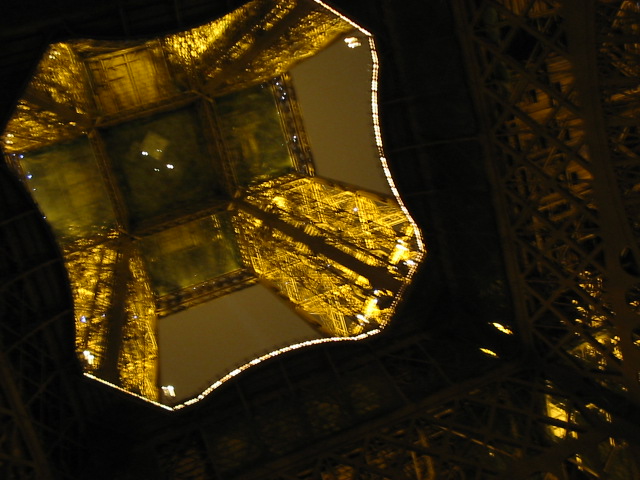
three times to Paris … three times to the Tour Eiffel … but only up in the elevators once. the most recent time, with Becca, was perhaps the most amusing. I don’t have particularly clear memories of the first two visits, apart from the fact that they were both during the day, and the second time we tried to figure out which riverside tunnel was the one in which Princess Diana died.
many Parisians decried the structure when it was completed in 1889 as an “eyesore” and, when asked why he ate lunch at the Tower’s restaurant every day, Guy de Maupassant explained that it was the only place in the city from which one could not see the tower (flimsy claim if you ask me). while it has become the quintessential landmark of the city, and depicted as visible from many an establishing-shot in movies, zoning regulations in Paris mean that very few buildings are actually tall enough to grant a clear view of the tower. initially, the construction contract called for the structure to be dismantled after twenty years, when ownership reverted to the city of Paris, but it proved valuable for communication purposes and remained standing. and now that it’s become part of the popular perception of the City of Light, more than 200 million people have visited the “eyesore”.
more from Wikipedia and the Tower’s site
tonight, while going through some photo albums for post ideas and realized that I’ve been to Paris on three separate occasions. that’s more than any other single international destination. (and I’m not counting London, though to get technical I came and went more than three times while I was there.)


the most authentically gothic cemetery I’ve ever visited was that of Pere Lachaise in Paris. even thinking of it now conjures up images from The Woman in White (which, I know, I know, is set in London). it was one of the first places that Becca and I visited on our weekend trip to Paris. westayed at this thoroughly budget (but clean, and really not that bad) hotel just a couple of blocks from the cemetery and got there early in the morning. it was autumn when we visited, and wonderfully sunny that day. there were fallen leaves everywhere, giving that wonderful leaf-kicking crunch.
 the cemetery has wide boulevards, off of which you can find many of the big-name internments, like Oscar Wilde, Honore de Balzac, Georges Bizet, Chopin, Saint-Cyr, Marcel Marceau, Moliere, Jim Morrison, Edith Piaf, Pissaro, Proust, Seurat, and Richard Wright. but as we didn’t have much of a plan in mind, we wandered around the narrower paths of the cemetery.
established by Napoleon in 1804, Pere Lachaise is the largest cemetery within the city of Paris. it was named for Francios de la Chaise, confessor to Louis XIV. cemeteries had been banned within the city limits in 1786 on the premise that they posed a health hazard. this lead to the creation of the catacombs, as well as cemeteries that fell outside the boundaries of the capital (such as the one in Montmartre). initially, the distance of Pere Lachaise from the city center proved a major disincentive for funerals, so the administrators concocted a marketing campaign that, with great fanfare, transferred the remains of La Fontaine and Moliere to the cemetery. the move worked and, in 1817, they also orchestrated the relocation of the purported remains of Piere Abelard and Heloise to the cemetery. within a few years, internments went from a few dozen to more than 33,000. there are now over 300,000 “permanent residents” buried in the Cemetery, and even more cremated remains housed in the columbarium.
 the Cemetery also has special meaning to the political left (apparently). in 1871, some 147 fédérés of the Paris Commune were shot and dumped into an open trench at the foot of a wall in the cemetery. leftist groups often hold parades through the grounds on the anniversary of the massacre (28 May), the largest of which took place in 1936 when some 600,000 people participated. in an ironic twist of fate, the man purportedly responsible for the events of the “Bloody Week” that culminated in the massacre at the Communards’ Wall (Adolphe Thiers) is also buried in Pere Lachaise.
(Pere Lachaise Cemetery on wikipedia and a tourist site)
one of my favorite things from our visit to Pere Lachaise, was this black cat. we actually saw several cats — surprise, surprise in a city full of feral cats — one of which disappeared into the tangle around a gated family tomb.

when I started looking for more information on this photo (which I’d labeled Greyfriar’s Cemetery), all I came up with were sites on Greyfriars Bobby in Edinburgh — decidedly not the information for which I was searching. enter Google Maps … it’s amazing how much detail the site has developed over the last couple of years. search for St. Paul’s in London and ta-da! only a few hundred yards away stand the remains of Christ Church Greyfriars (also known as Christ Church Newgate, as it stands on the Newgate road).
 the second church was designed by Sir Christopher Wren (who designed a total of 51 churches after the Great Fire, including St. Paul’s across Newgate St from this church) and completed in 1687 (though it took another 30-odd years before a steeple was placed atop the church tower). for many years, the church served as an important center for society and music in London, but the size of the parish declined significantly around the turn of the twentieth century, as the area gave way to more and more businesses and the employees of the businesses moved farther out to suburbs and the Home Counties. by 1937, there were only 77 parishioners and, following a post-war reorganization of the Church of England, the parish was merged with another.
while the parish staggered on until 1954, Wren’s church suffered devastating damage during the Blitz. on December 29, 1940, one of the worst bombing raids during the war, the Christ Church Greyfriar’s was hit, along with much of the surrounding neighborhoods. a total of 8 of Wren’s churches were damaged or destroyed that same night. the church spire, however, did emerge relatively unscathed and was disassembled in 1960 and reconstructed using modern reinforcement techniques. the spire now houses residences on twelve levels, and the grounds that were once the nave are now a public garden and memorial.
 while we’re on the subject of cemeteries, I thought I’d write about my favorite cemetery in San Diego County — the one at Fort Rosecrans on Point Loma.
Point Loma was one of the first places that I visited when I went to San Diego the first time in April of 2006. resting as it does on the ridge of the peninsula, the cemetery has spectacular views of both the San Diego Harbor and the Pacific Ocean. the cemetery and military base of which it is a part were named after a Union general from the Civil War, William Starke Rosecrans. the cemetery has a surprisingly long history — participants in the Battle of San Pasqual (about which more later) were re-interred (after initially being buried where they fell) at the military cemetery in 1874.
 some other notable residents of the cemetery include a slew of Medal of Honor recipients (the most recent of which received the honor in 2006, but the last one before that was in the 1960s). also, a Major Reuben Fleet, a WWI aviator and perhaps now best known as patron of the Reuben H. Fleet Space Theater and Science Center in Balboa Park. another well-known name in San Diego: Major General Joseph H. Pendleton is buried at Fort Rosecrans. he graduated from the US Naval Academy and was commissioned a second lieutenant in the Marine Corps in 1884. he rose to the rank of colonel and, in mid-1914 after arriving in San Diego, began advocating for the establishment of a major Marine Corps installation in the area due to the weather and harbor. he retired in 1924 and settled in Coronado, where he served as mayor for a time. he died in 1942 and later the same year, construction began on the Pendleton Marine Corps Base outside of Oceanside.
the grounds became a National Cemetery in 1934 and, while they still have room for cremated remains, the only room for caskets is in sites shared by previously interred family members.